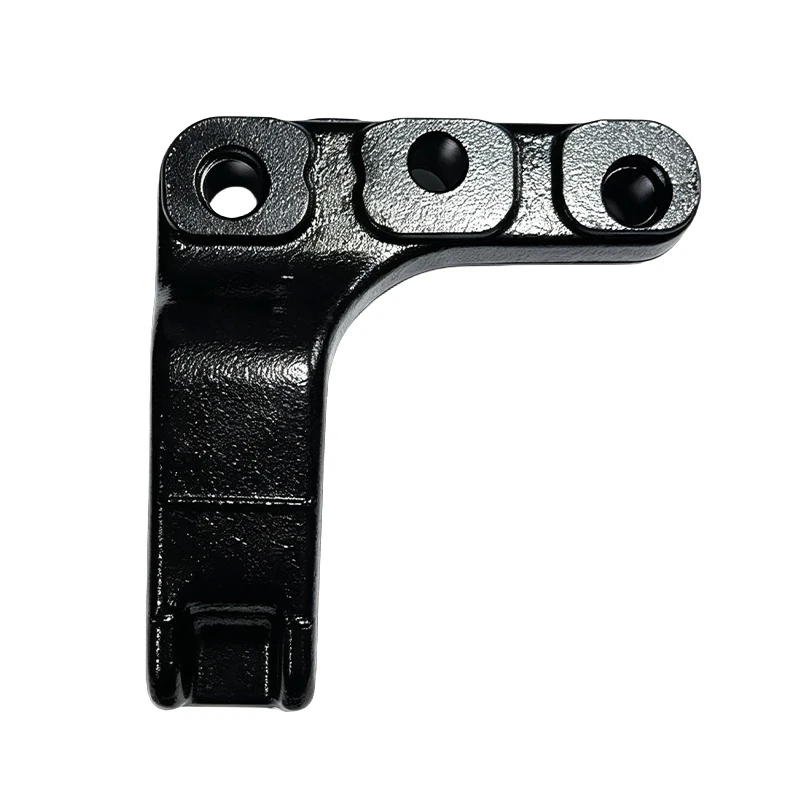
Mounting and suspension connection components are important parts of automotive powertrain and chassis systems. They are designed to provide structural connection, support, positioning, and vibration control between different vehicle assemblies. Because powertrain layouts, suspension architectures, and chassis designs vary among vehicles, the configuration of these components can differ significantly. Common designs include mounting brackets, elastomeric bushings, support structures, and articulated connection components.
Mounting brackets are among the most widely used designs. They provide structural support for the powertrain or suspension assemblies and are commonly manufactured from metal using forming, stamping, bending, or fabricated construction methods. Their geometry is tailored to the available installation space, with precisely positioned mounting holes and interfaces. A suitable bracket must provide sufficient strength and stiffness while maintaining accurate compatibility with the vehicle body and connected assemblies.
Bushing-type components are primarily used where flexible connection and vibration isolation are required. Rubber bushings and other elastomeric elements can be integrated into mounting or suspension connection points. They maintain the structural connection while allowing controlled elastic movement. When the vehicle experiences vibration or impact, the elastomer can absorb part of the energy, reducing the amount of vibration transmitted directly into the vehicle body.
Support and connection structures are designed to secure assemblies and transfer operational loads. Their geometry is generally developed according to the installation position, available space, and expected load directions. Dimensional accuracy and structural integrity are particularly important because these characteristics can influence assembly quality and long-term connection stability.
Articulated connection components, including ball-joint-based designs, are used where controlled relative movement is required. These components allow rotation through a specified range while transmitting the required mechanical loads. Smooth articulation, wear resistance, and connection reliability are important considerations for this type of application, particularly within suspension systems.
Some powertrain mounting systems also use hydraulic or hybrid mounting designs. These structures combine elastomeric elements with additional damping mechanisms to provide more sophisticated vibration control. Their characteristics can be tailored to the vibration behavior and operating requirements of specific vehicle platforms.
Overall, mounting and suspension connection components are available in a variety of structural forms, each serving different requirements for fastening, support, vibration isolation, or controlled movement. Selection should take into account the vehicle architecture, installation location, load conditions, and operating environment. As automotive chassis technology continues to evolve, these components are expected to become lighter, stronger, more precise, and increasingly optimized for vibration control.